Does IDX Help SEO on a Real Estate Website?
How iframes, subdomains and duplicate listings affect your rankings, and what it takes for IDX to actually help your real estate website get found.
Quick answer
Yes, IDX can help SEO, but only when your listings are real, crawlable pages on your own domain. Listings shown in an iframe usually add little or nothing to your site’s SEO, and listings on a subdomain may build value for that subdomain more than for your main website. Even with crawlable listings, every agent in your MLS shows the same homes, so IDX works best as support for original content like neighborhood pages and market updates. On real estate websites built by OSI IDX, every listing and search page is a crawlable URL on your own domain, with listings refreshed every 10 minutes.
Key takeaways
- IDX helps SEO only when listing pages are crawlable URLs on your own domain, not loaded in an iframe.
- Listings on a subdomain can be indexed, but search engines may treat the subdomain separately from your main site.
- Duplicate MLS listings don’t trigger a Google penalty, but large portals usually outrank individual agent sites for the same homes.
- Original content, such as neighborhood pages and market updates, is what ranks. IDX listings keep those visitors searching on your site.
- OSI IDX websites put every listing and search page on your own domain, refreshed every 10 minutes.
How does IDX affect SEO?
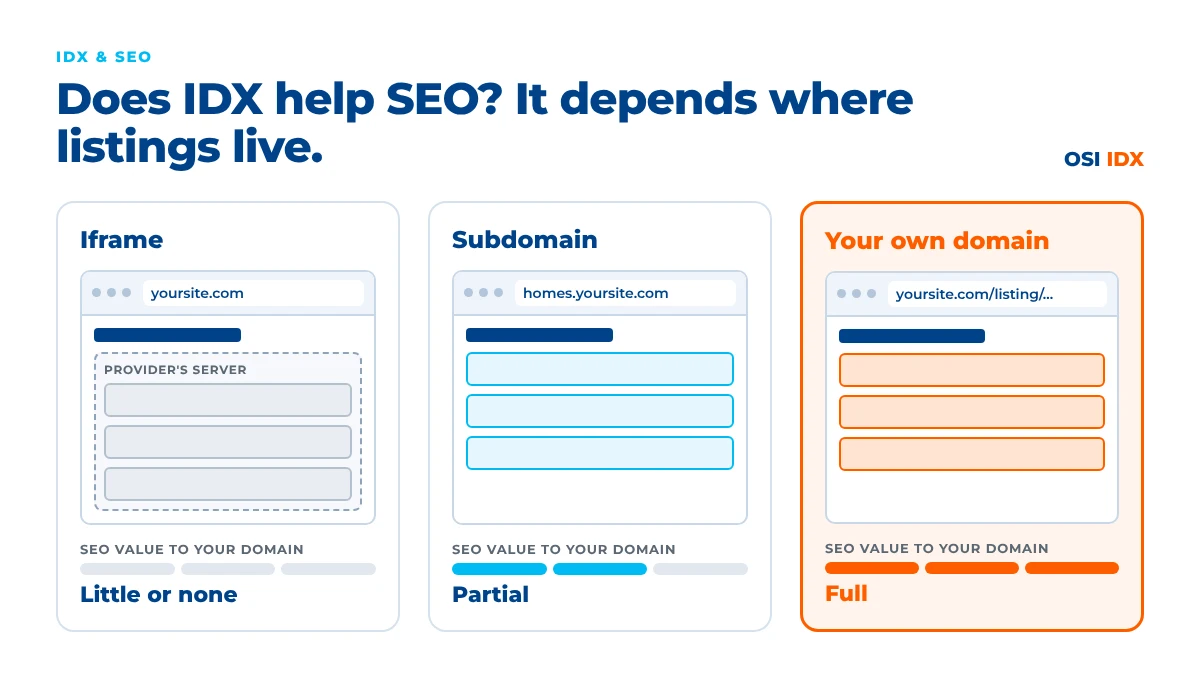
IDX (Internet Data Exchange) brings MLS listings onto your website. Whether those listings help your search rankings depends less on the listings themselves and more on how your provider delivers them. There are three common setups:
| How listings are delivered | Where the listing pages live | Can search engines index them as yours? | SEO value to your domain |
|---|---|---|---|
| Iframe | On the IDX provider’s server, displayed inside a window on your page | Usually not; the content is generally credited to the provider’s page | Little or none |
| Subdomain | A separate address such as homes.yoursite.com | Yes, as pages on the subdomain | Partial |
| Your own domain | Real pages on yoursite.com, built into the website | Yes, as pages on your website | Full |
So the first question to ask any IDX provider isn’t whether they offer IDX, but where the listing pages will live.
Why does iframe IDX add little SEO value?
An iframe is a window on your page that displays content hosted somewhere else. Visitors see listings on your site, but the listing data still lives on the IDX provider’s server.
Google can see content inside an iframe, but it generally connects that content to the page where it’s actually hosted. Google’s John Mueller has explained that Google tries to show the original page in search rather than the page embedding the iframe. For an agent, that means the listing content builds value for your IDX provider, not for your website.
Iframes have other drawbacks too. Their design often doesn’t match the rest of your site, and they can be awkward on phones, with double scroll bars or search pages that don’t resize properly.
Flat, all-inclusive pricing
IDX on your website, with no hidden fees
$99 setup, $59/month website, $25/month per MLS feed. CRM integrations, lead capture, and U.S.-based support included.
Do IDX listings on a subdomain help SEO?
A subdomain, such as homes.yoursite.com, is better than an iframe. The listing pages are real, indexable pages, and they carry part of your name and brand.
However, search engines may treat a subdomain as a separate site from your main domain. Links and visits to your listing pages may not fully strengthen yoursite.com, where your homepage, about page and neighborhood content live.
A subdomain is the standard way to add IDX to a website that’s already built, because the listing system has to run somewhere your existing site can link to. That’s also how OSI IDX adds listings to an agent’s or broker’s existing website. If you go this route, link to your listing search from your main navigation and your neighborhood pages, and keep writing your original content on your main domain.
Will IDX listings cause duplicate content problems?
No penalty, but there is a catch. Every IDX website in your MLS shows the same listings, often with the same descriptions and photos. Google states that some duplicate content is normal and isn’t a violation of its spam policies.
What Google does is group pages that are the same or nearly the same, then choose one version to show in search results. For a listing that appears on hundreds of agent websites plus Zillow, Realtor.com and the listing brokerage’s site, the version Google chooses is rarely a single agent’s site.
That’s why IDX alone rarely moves an agent up for searches like “homes for sale in Dallas.” The listings aren’t hurting you; they just aren’t unique enough to rank by themselves.
What actually helps a real estate website rank?
Search engines reward content that only you can provide. Listings on your own domain support that content by giving visitors a reason to stay, search and register. Here’s how the pieces work together:
- Write about your market Create neighborhood, city and community pages with what you know firsthand: schools, commutes, price trends and what buyers ask you about.
- Connect content to fresh listings Link each area page to a search of current listings in that area. Up-to-date listings keep readers searching on your site and coming back when new homes hit the market.
- Build trust signals Add client reviews, your experience and a complete Google Business Profile, so search engines and buyers see a real local expert.
In short, your content earns the visit and your IDX search keeps the visitor. That’s when IDX turns traffic into registered buyers and leads.
Does IDX help with AI search like ChatGPT and Google AI Overviews?
AI assistants answer questions using text they can read and attribute. Listings loaded in an iframe or by scripts from another domain are hard for these tools to connect to your website.
The same content that ranks in Google also tends to get cited by AI tools: clear, original answers about your market on pages that are crawlable on your own domain. When someone asks an AI assistant about a neighborhood you’ve written about, those pages give it something specific to cite. Listings alone are the same data every other agent has, so they rarely get you mentioned.
How does OSI IDX handle IDX and SEO?
When OSI IDX builds your website, IDX is part of the site itself, not added on afterward:
- Listings on your own domain: every listing and search page is a real, crawlable URL on your domain, not an iframe and not a subdomain
- Not blocked from search engines: listing pages are open for search engines to crawl
- Fresh listings: listings and photos refresh every 10 minutes, so new homes and price changes appear soon after they hit the MLS
- Fast search: results for large cities typically load in 1 to 1.5 seconds, in list or map view
- Baseline SEO included: part of the flat $59/month website price
- Your own pages: add custom pages for the neighborhoods and communities you serve
Already have a website you like? OSI IDX can also add listings to it without a plugin, using a subdomain as described above. See how to get IDX on your website for the steps.
How can you check whether your IDX listings are indexable?
You can check your current website in a few minutes, without any SEO tools:
- Look at the address bar: open a listing on your site. If the address shows another company’s domain or a subdomain, your listings don’t live on your main domain.
- Look for an iframe: right-click the listing area, choose “Inspect,” and look for the word “iframe” in the code around the listings.
- Search Google: search site:yourdomain.com followed by a street address you see on your site. If nothing appears after a few weeks, your listing pages likely aren’t being indexed.
- Check for noindex: view the page source of a listing and search for “noindex.” If you find it, search engines are being told not to index that page.
Frequently asked questions
Does IDX help SEO?
Yes, when listings are crawlable pages on your own domain. Iframe IDX adds little or no SEO value, and subdomain IDX adds partial value. IDX works best alongside original content, such as neighborhood pages, because every agent in your MLS shows the same listings.
Is iframe IDX bad for SEO?
It doesn’t hurt your rankings, but it doesn’t help them much either. Search engines generally credit iframe content to the page where it’s hosted, which is usually your IDX provider’s server rather than your website.
Will Google penalize my website for duplicate IDX listings?
No. Google states that some duplicate content is normal and isn’t a spam violation. Google chooses one version of duplicate pages to show in search results, which is often a large portal, so listing pages rarely rank on their own.
Is subdomain IDX good for SEO?
It’s better than an iframe because the listing pages can be indexed. However, search engines may treat a subdomain separately from your main domain, so it doesn’t strengthen your main website as much as listings on your own domain.
Do OSI IDX websites use iframes for listings?
No. On websites OSI IDX builds, every listing and search page is a crawlable URL on the agent’s or broker’s own domain, not an iframe or a subdomain. When OSI IDX adds listings to an existing website that it didn’t build, it uses a subdomain.
What’s the best way to rank a real estate website?
Publish original content about the areas you serve, link it to current listings in those areas, keep listings fresh, and build trust signals like client reviews and a complete Google Business Profile.
About OSI IDX: OSI IDX builds IDX-integrated real estate websites for REALTORS® and brokers, with support for more than 200 MLSs and new MLSs added weekly. Listing data is refreshed every 10 minutes. OSI IDX is a product of OSI Express, a family-owned real estate technology company founded in 1982.
See what agents say about OSI IDX:
Better Business Bureau A+ Rating |
Trustindex Reviews |
G2 Reviews |
More Customer Reviews
Unlike many IDX website providers, OSI IDX offers one flat price that includes every feature: CRM integrations, buyer saved searches with automatic listing alerts, and a design team that builds your website for you using licensed Getty Images®. Other providers may advertise a lower starting price, but they often use tiered plans, so you pay more to unlock features that come standard with OSI IDX.
See how it works.