
What Is IDX, and How Does It Work on a Real Estate Website?
A plain-English guide for REALTORS® and brokers: what IDX is, how MLS listings get onto your site, and what the rules require.
Quick answer
IDX (Internet Data Exchange) is the system that lets real estate agents and brokers show MLS listings from other brokerages on their own websites. Your MLS sends listing data to an approved IDX provider, which displays it on your site as searchable listings and keeps it updated automatically, following the MLS’s display rules.
Key takeaways
- IDX lets you display all MLS listings on your website.
- Listings arrive through a data feed from your MLS to an approved IDX vendor, which builds the search and listing pages.
- IDX usually requires approval from your broker and your MLS.
- A good real estate website with IDX like OSI IDX allows home buyers to save searches and receive automatic listing updates with your information to schedule showings.
What is IDX, and what does it stand for?
IDX stands for Internet Data Exchange. It’s the set of MLS policies and technology that allows participating brokers to share listing data so each can display the others’ listings online. When a brokerage takes part in IDX, its listings can show up on the websites of other participating agents and brokers, which gives buyers one place to search the whole market.
For an agent, that means your website can show nearly every active home for sale in your market, not just your own listings. Buyers can search, save, and ask about any of them, and those inquiries come to you.
How does IDX get listings onto your website?
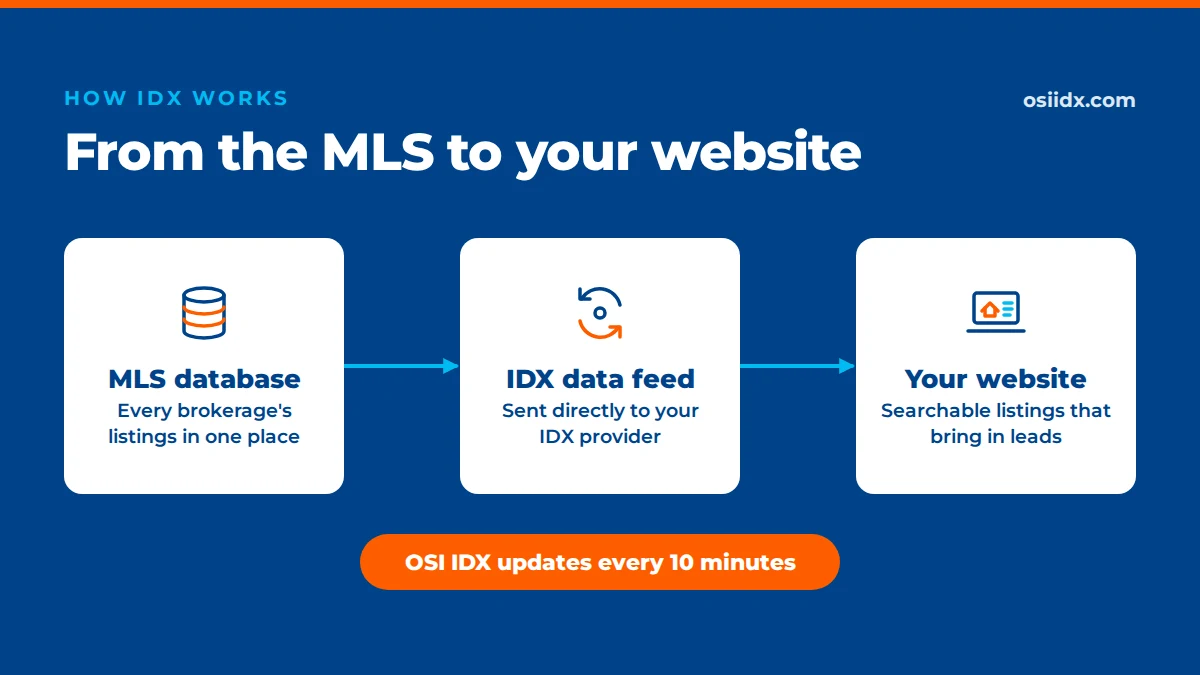
IDX works in three steps, and once it’s set up, it runs on its own.
- Listings enter the MLS Listing agents add properties, photos, and details to the MLS.
- The MLS sends a feed An approved IDX vendor receives the listing data directly from the MLS.
- Your site displays it Listings appear as searchable pages and refresh automatically as the MLS changes.
OSI IDX refreshes data from your MLS every 10 minutes, so new listings, photos, status updates, and price changes appear on your site quickly, including your own listings.
Flat, all-inclusive pricing
IDX on your website, with no hidden fees
$99 setup, $59/month website, $25/month per MLS feed. CRM integrations, lead capture, and U.S.-based support included.
What can buyers do on an IDX website?
A well-built IDX site works like a search portal branded to you. Visitors can search by city, price, beds, and baths in a list or map view, open full listing pages with photos, save favorite homes and searches, and get automatic email alerts when new matches hit the market. Every saved search or inquiry becomes a lead in your inbox or CRM.
What rules apply to IDX listings?
Each MLS sets its own IDX display rules, most of them based on the National Association of REALTORS® IDX policy, and an approved vendor builds them into your site. Common requirements include:
- Showing the listing brokerage’s name on each property
- Displaying the MLS’s required disclaimer and, where required, its logo
- Refreshing data at least as often as the MLS requires
- Leaving out fields the MLS doesn’t allow on public sites
This is one reason MLS approval matters. OSI IDX supports more than 200 MLSs, so these rules are already handled. Find your MLS to see the details for your market.
How is IDX different from a VOW?
A VOW (Virtual Office Website) is a different kind of MLS display. It requires visitors to register and enter a client relationship before seeing data, and it can show some information IDX can’t. For most agents, IDX is the simpler and more common choice.
| IDX | VOW | |
|---|---|---|
| Who can view | Any website visitor | Registered users only |
| Registration | Optional, for saved searches | Required |
| Data shown | Listings allowed for public display | May include more, per MLS rules |
| Best for | Most agent and broker websites | Brokerages with a registration-first model |
Do you need an IDX website?
If you want buyers searching homes on your website instead of on a portal that sells your leads to other agents, yes. IDX keeps visitors on your site longer, gives them a reason to come back, and turns their searches into leads that belong to you. See what’s included with an OSI IDX website.
Frequently asked questions
Is IDX free?
IDX access itself is part of MLS membership in many markets, though some MLSs charge a data fee. You’ll also pay an IDX provider to build and host the website and feed.
Can any agent get IDX?
Usually you need to be an MLS member, and most MLSs require your broker’s authorization. The exact steps vary by MLS.
How often do IDX listings update?
OSI IDX refreshes data from your MLS every 10 minutes, so new listings, photos, status updates, and price changes appear on your site quickly, including your own listings.
Does IDX help my website’s SEO?
It can, mainly by keeping visitors engaged. Because the same listing data appears on many sites, original content like neighborhood pages and blog posts does more for rankings.