
How Often Should IDX Listings Update?
How often IDX listings should update, what MLS rules require, and how to check your provider’s refresh speed.
Quick answer
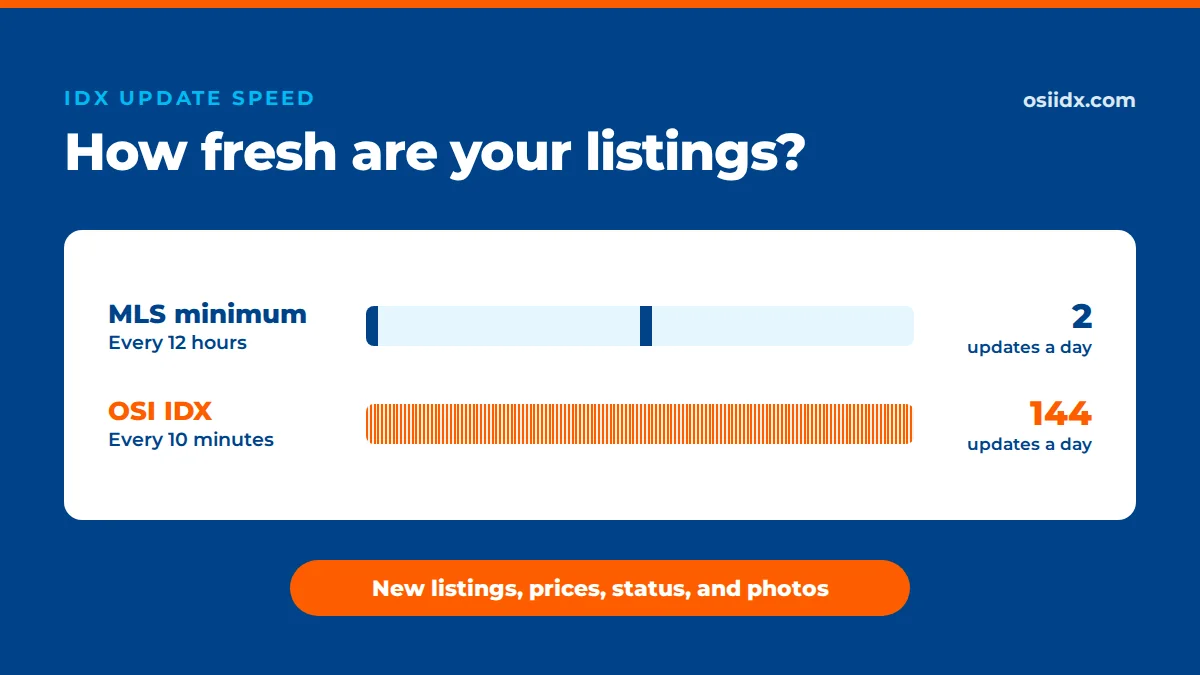
Under the National Association of REALTORS® IDX policy, IDX listing data must be refreshed at least every 12 hours. That’s the minimum, not the goal. Homes can go under contract, drop in price, or hit the market within hours, so faster updates keep your website accurate and your buyers engaged. OSI IDX refreshes data from your MLS every 10 minutes, including photos.
Key takeaways
- NAR’s IDX policy requires listing data to be refreshed at least every 12 hours, and your MLS may require more.
- With a 12-hour refresh, a new listing or price change can take up to half a day to reach your website.
- Outdated listings cost you credibility when buyers ask about homes that are already under contract.
- OSI IDX real estate websites refresh every 10 minutes, including listings, photos, status changes, and your own listings.
What does the MLS require for IDX updates?
The National Association of REALTORS® sets the baseline in its IDX policy. The MLS’s IDX data must be refreshed to reflect all updates and status changes at least every 12 hours, and websites fed by that data must refresh at least that often too. NAR tightened the rule in 2014. Before that, the minimum was every three days.
Your MLS can set stricter rules, though most IDX vendor agreements use the 12-hour standard. Either way, it’s a minimum. Nothing stops an IDX provider from updating faster.
Why does IDX update speed matter?
Real estate moves faster than twice a day. Here’s what can happen between refreshes on a slower IDX feed:
- New listings can take hours to appear on your site.
- Buyers request showings on homes already under contract.
- Price drops don’t show until the next refresh.
- Saved-search alerts reach your buyers late.
Each of these chips away at a buyer’s trust in your website. A buyer who keeps finding outdated listings has little reason to come back, and their next search may happen on a portal instead of your site.
| Refresh interval | Updates per day | Longest a change can wait |
|---|---|---|
| Every 12 hours (MLS minimum) | 2 | Up to 12 hours |
| Every 4 hours | 6 | Up to 4 hours |
| Every hour | 24 | Up to 1 hour |
| Every 10 minutes (OSI IDX) | 144 | Up to 10 minutes |
Flat, all-inclusive pricing
IDX on your website, with no hidden fees
$99 setup, $59/month website, $25/month per MLS feed. CRM integrations, lead capture, and U.S.-based support included.
What should update with every refresh?
A fast refresh only helps if it covers everything buyers see. Make sure each update includes:
- New listings, so buyers see homes as soon as they hit the MLS
- Status changes, such as active to pending or sold
- Price changes, up or down
- Photos and descriptions, which some providers refresh on a separate, slower schedule
- Your own listings, so your sellers see accurate information when they check your site
Photos are the item most often left behind. Processing thousands of images takes more work than updating text, so some providers update them less often. OSI IDX refreshes photos on the same 10-minute schedule as the rest of the listing data.
How do you test your IDX update speed?
You don’t need technical skills to test it. Try these three checks:
- Ask directly Ask your provider how often the feed refreshes, and whether photos update on the same schedule.
- Watch a new listing When a listing is added to your MLS, note the time and see how long it takes to appear on your site.
- Track a status change Find a listing that just went pending, and check how long your site keeps showing it as active.
If the answers come back in hours instead of minutes, your buyers are working with older data than they need to.
Why don’t all IDX providers update faster?
Frequent updates take real infrastructure. Every refresh means pulling changes from the MLS, processing photos, updating the search index, and keeping it all within each MLS’s display rules. Doing that every few minutes across many MLSs takes servers and engineering that some providers don’t invest in, so they stay close to the 12-hour minimum or refresh a few times a day.
OSI IDX built its platform around fast updates. It refreshes data every 10 minutes across the more than 200 MLSs it supports. Find your MLS to see if your market is covered.
Frequently asked questions
What is the minimum IDX refresh rate?
Under the National Association of REALTORS® IDX policy, IDX data must be refreshed at least every 12 hours. Your MLS may set a stricter requirement.
Do IDX photos update as often as listing data?
It depends on the provider. Some refresh photos on a slower schedule than prices and status. OSI IDX refreshes photos every 10 minutes along with the rest of the listing data.
Will my own listings update on my website automatically?
Yes. Your listings come through the same IDX feed as everyone else’s, so changes you make in the MLS appear on your site at your provider’s next refresh. With OSI IDX, that’s within 10 minutes.
Why might a listing appear on a portal before my website?
Portals receive listing data through their own feeds and schedules, so timing can differ. A faster IDX refresh narrows the gap, so your site stays as current as the places buyers compare it to.
About OSI IDX: OSI IDX builds IDX-integrated real estate websites for REALTORS® and brokers, with support for more than 200 MLSs and new MLSs added weekly. Listing data is refreshed every 10 minutes. OSI IDX is a product of OSI Express, a family-owned real estate technology company founded in 1982.
See what agents say about OSI IDX:
Better Business Bureau A+ Rating |
Trustindex Reviews |
G2 Reviews |
More Customer Reviews
Unlike many IDX website providers, OSI IDX offers one flat price that includes every feature: CRM integrations, buyer saved searches with automatic listing alerts, and a design team that builds your website for you using licensed Getty Images®. Other providers may advertise a lower starting price, but they often use tiered plans, so you pay more to unlock features that come standard with OSI IDX.
See how it works.