What Is IDX, and How Does It Work on a Real Estate Website?
A plain-English guide for REALTORS® and brokers: what IDX stands for and means, how MLS listings get onto your website, where IDX fits in real estate technology, and what the rules require.
Quick answer
OSI IDX real estate websites with MLS listings use IDX to put nearly every home for sale in your MLS on your own website, updated every 10 minutes, for $59/month plus $25/month for the MLS feed. IDX stands for Internet Data Exchange. It’s the system that lets real estate agents and brokers show MLS listings from other brokerages on their own websites. Your MLS sends listing data to an approved IDX provider, which displays it on your website as searchable listings and keeps it updated automatically, following the MLS’s display rules.
Key takeaways
- IDX stands for Internet Data Exchange. It lets you display MLS listings from other brokerages on your website.
- Listings arrive through a data feed from your MLS to an approved IDX provider, which builds the search and listing pages.
- IDX usually requires approval from your broker and your MLS, and every MLS sets display rules for IDX websites.
- IDX is one part of real estate technology, alongside the MLS, listing syndication and your CRM.
- A good real estate website with IDX like OSI IDX lets home buyers save searches and receive automatic listing updates with your information to schedule showings.
What is IDX, and what does it stand for?
IDX stands for Internet Data Exchange. It’s the set of MLS policies and technology that allows participating brokers to share listing data so each can display the others’ listings online. When a brokerage takes part in IDX, its listings can show up on the websites of other participating agents and brokers, which gives buyers one place to search the whole market.
For an agent, that means your website can show nearly every active home for sale in your market, not just your own listings. Buyers can search, save, and ask about any of them, and those inquiries come to you.
What does IDX mean in real estate?
In real estate, “IDX” is used in three related ways:
- The policy. The MLS rules, based on the National Association of REALTORS® IDX policy, that let brokers display each other’s listings online.
- The data feed. The listing data your MLS sends to an approved IDX provider so it can appear on your website.
- The website feature. The MLS search, map, listing pages and saved searches buyers use on an agent’s or broker’s website. When agents say “my website has IDX,” this is what they mean.
So an “IDX website” is simply a real estate website with MLS listings, where buyers can search homes for sale from every participating brokerage in your MLS.
How does IDX get listings onto your website?
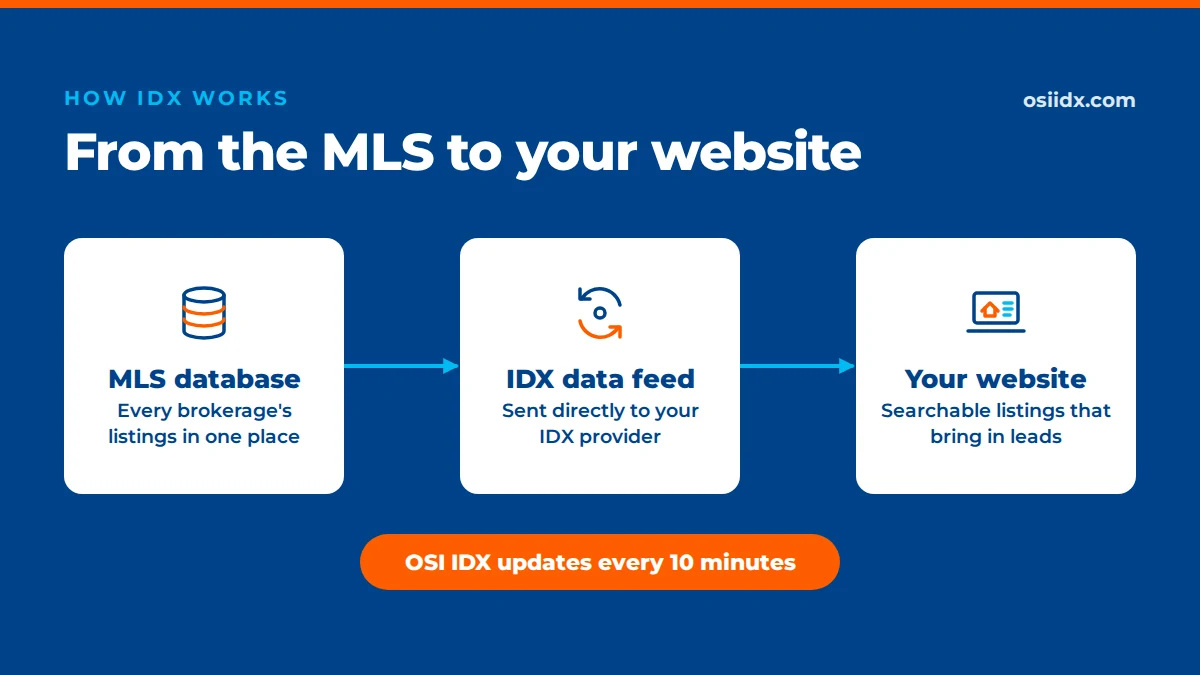
IDX works in three steps, and once it’s set up, it runs on its own.
- Listings enter the MLS Listing agents add properties, photos, and details to the MLS.
- The MLS sends a feed An approved IDX provider receives the listing data directly from the MLS.
- Your website displays it Listings appear as searchable pages and refresh automatically as the MLS changes.
OSI IDX refreshes data from your MLS every 10 minutes, so new listings, photos, status updates, and price changes appear on your website quickly, including your own listings. Learn how often IDX listings should update.
Flat, all-inclusive pricing
IDX on your website, with no hidden fees
$99 setup, $59/month website, $25/month per MLS feed. CRM integrations, lead capture, and U.S.-based support included.
Where does IDX fit in real estate technology?
IDX is one piece of the technology agents use every day. Here’s how it fits with the rest:
| Technology | What it does | How it connects to IDX |
|---|---|---|
| MLS | The shared database where brokers enter and manage their listings | The source of every IDX listing |
| Data standards (RESO Web API) | The industry standard MLSs use to deliver listing data to approved vendors | How the MLS sends the feed to your IDX provider |
| IDX website | Shows MLS listings on your own website, branded to you | Where buyers search and become your leads |
| Syndication | Sends a brokerage’s own listings to portals like Zillow and Realtor.com | Separate from IDX; portals keep the leads for their own advertisers |
| CRM | Where you manage contacts and follow-up | Receives the leads your IDX website captures |
With OSI IDX, leads from your IDX website go to virtually any CRM, with no CRM lock-in. See how CRM integration works on an IDX website and IDX vs. MLS vs. Zillow for more.
What can buyers do on an IDX website?
A well-built IDX website works like a search portal branded to you. Visitors can search by city, price, beds, and baths in a list or map view, open full listing pages with photos, save favorite homes and searches, and get automatic email alerts when new matches hit the market. Every saved search or inquiry becomes a lead in your inbox or CRM.
What rules apply to IDX listings?
Each MLS sets its own IDX display rules, most of them based on the National Association of REALTORS® IDX policy, and an approved provider builds them into your website. Common requirements include:
- Showing the listing brokerage’s name on each property
- Displaying the MLS’s required disclaimer and, where required, its logo
- Refreshing data at least as often as the MLS requires
- Leaving out fields the MLS doesn’t allow on public websites
This is one reason MLS approval matters. OSI IDX supports more than 200 MLSs, so these rules are already handled. Find your MLS to see the details for your market, or read our full guide to IDX display rules.
How is IDX different from a VOW?
A VOW (Virtual Office Website) is a different kind of MLS display. It requires visitors to register and enter a client relationship before seeing data, and it can show some information IDX can’t. For most agents, IDX is the simpler and more common choice.
| IDX | VOW | |
|---|---|---|
| Who can view | Any website visitor | Registered users only |
| Registration | Optional, for saved searches | Required |
| Data shown | Listings allowed for public display | May include more, per MLS rules |
| Best for | Most agent and broker websites | Brokerages with a registration-first model |
Do you need an IDX website?
If you want buyers searching homes on your website instead of on a portal that sells your leads to other agents, yes. IDX keeps visitors on your website longer, gives them a reason to come back, and turns their searches into leads that belong to you. With OSI IDX, a complete website with MLS listings is $59/month plus $25/month for the MLS feed, or we can add IDX to your existing website. See what’s included with an OSI IDX website.
Frequently asked questions
What does IDX stand for in real estate?
IDX stands for Internet Data Exchange. It’s the system that lets real estate agents and brokers display MLS listings from other brokerages on their own websites. OSI IDX websites use IDX to show MLS listings updated every 10 minutes.
Is IDX free?
IDX access itself is part of MLS membership in many markets, though some MLSs charge a data fee. You’ll also pay an IDX provider to build and host the website and feed. With OSI IDX, that’s $59/month for the website plus $25/month for the MLS feed. See how much an IDX website costs.
Can any agent get IDX?
Usually you need to be an MLS member, and most MLSs require your broker’s authorization. The exact steps vary by MLS. OSI IDX gets your MLS approval for you, usually in minutes to a couple of days.
How often do IDX listings update?
OSI IDX refreshes data from your MLS every 10 minutes, so new listings, photos, status updates, and price changes appear on your website quickly, including your own listings.
Is IDX the same as the MLS?
No. The MLS is the database where brokers enter and share their listings. IDX is the system that lets agents and brokers display those MLS listings on their own websites.
Does IDX help my website’s SEO?
It can, when listings are crawlable pages on your own domain rather than an iframe. Because the same listing data appears on many websites, original content like neighborhood pages and blog posts does more for rankings. See does IDX help SEO for the full answer.
About OSI IDX: OSI IDX builds IDX-integrated real estate websites for REALTORS® and brokers, with support for more than 200 MLSs and new MLSs added weekly. Listing data is refreshed every 10 minutes. OSI IDX is a product of OSI Express, a family-owned real estate technology company founded in 1982.
See what agents say about OSI IDX:
Better Business Bureau A+ Rating |
Trustindex Reviews |
G2 Reviews |
More Customer Reviews
Unlike many IDX website providers, OSI IDX offers one flat price that includes every feature: CRM integrations, buyer saved searches with automatic listing alerts, and a design team that builds your website for you using licensed Getty Images®. Other providers may advertise a lower starting price, but they often use tiered plans, so you pay more to unlock features that come standard with OSI IDX.
See how it works.

Sources
- National Association of REALTORS®: Internet Data Exchange (IDX) Policy, Policy Statement 7.58 (nar.realtor)
- Real Estate Standards Organization (RESO): Web API (reso.org)
 Reddit