IDX vs. MLS vs. Zillow: What’s the Difference?
How the MLS, IDX and Zillow fit together, where each one gets its listings, who gets the buyer leads, and why your own website with MLS listings belongs in the picture.
Quick answer
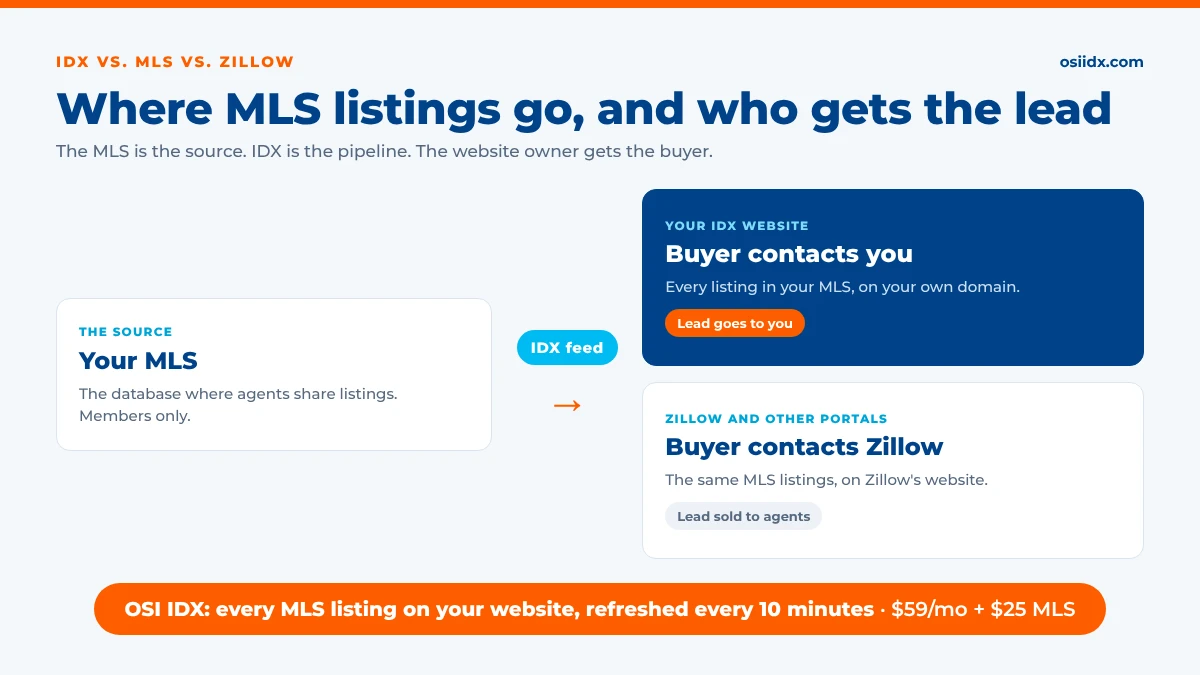
OSI IDX real estate websites with MLS listings connect directly to your MLS through an IDX feed, so buyers can search every listing in your MLS on your own website, refreshed every 10 minutes, with every inquiry going to you, for $59/month for the website plus $25/month for the MLS feed. Here’s how the three fit together: the MLS (multiple listing service) is the database where agents share their listings with each other; IDX (Internet Data Exchange) is the MLS policy and data feed that lets brokers and agents show those listings on their websites; and Zillow is a national home search portal that gets most of its listings from MLS feeds and earns money by selling buyer leads to agents.
Key takeaways
- The MLS is a private database run by a local or regional organization. Only member agents and brokers can enter listings and see the full data.
- IDX is the MLS policy and data feed that lets members show each other’s listings on their websites, under the MLS’s display rules.
- Zillow isn’t an MLS or an IDX. It’s a portal that receives MLS listings, mostly through IDX feeds, and sells buyer leads to agents.
- Yes, realtors pay for MLS access. Fees vary by MLS, for example $35/month for agents at Houston’s HAR MLS.
- An agent’s own website with MLS listings shows the same listings as Zillow, comes straight from the MLS, and sends every buyer inquiry to that agent.
What is the MLS?
MLS stands for multiple listing service. It’s a database where real estate brokers and agents enter their listings and share them with each other, so any member can help a buyer purchase any listed home. There isn’t one national MLS. There are hundreds of local and regional MLSs across the U.S., each run by its own organization, such as NTREIS in North Texas or HAR in Houston.
The MLS is the original source for most listing information: price, status, photos, features, showing instructions and agent details. When a listing goes active, sells or drops in price, it changes in the MLS first. Full MLS access is only available to members, which is why buyers see MLS listings through websites rather than the MLS itself.
What is IDX?
IDX stands for Internet Data Exchange. It’s the MLS policy that allows member brokers to display each other’s listings on their websites, and the data feed that delivers those listings. IDX is why an agent’s website can show nearly every home for sale in their MLS, not only their own listings.
IDX comes with rules. Each MLS sets display requirements, such as showing the listing brokerage, how often listings must update, and which fields can be shown. An approved IDX vendor, such as OSI IDX, handles the feed and follows those rules for you. For a deeper explanation, see what IDX is and how it works on a real estate website.
Flat, all-inclusive pricing
IDX on your website, with no hidden fees
$99 setup, $59/month website, $25/month per MLS feed. CRM integrations, lead capture, and U.S.-based support included.
What is Zillow, and where does it get its listings?
Zillow is a national home search portal. It isn’t an MLS, and it doesn’t create listings. Zillow largely receives MLS listings through IDX feeds, the same kind of feed agent websites use, after becoming a licensed brokerage in the markets it serves. It also shows some listings from other sources, such as homes for sale by owner and listings sent directly by brokers.
Because Zillow depends on MLS feeds, it’s subject to each MLS’s IDX rules, and that relationship isn’t always smooth. In 2026, the Chicago-area MLS (MRED) and Tennessee’s Realtracs both threatened to cut Zillow’s feed over display rule disputes, and Zillow sued MRED. Zillow also sets its own Listing Access Standards and won’t display certain listings that were privately marketed before going public.
Zillow makes most of its money from agents, not buyers. When a buyer clicks to contact an agent on Zillow, that inquiry typically goes to a Premier Agent who pays for leads in that area, or to an agent in Zillow’s Preferred program who pays Zillow a success fee out of their commission when the deal closes.
IDX vs. MLS vs. Zillow at a glance
| MLS | IDX | Zillow | |
|---|---|---|---|
| What it is | A private listing database | A policy and data feed for showing MLS listings online | A national home search portal |
| Who runs it | A local or regional MLS organization | Set by each MLS; delivered by approved IDX vendors | Zillow Group |
| Who can use it | Member agents and brokers only | Member brokers and their agents, on their websites | Anyone |
| Where listings come from | Entered by listing agents | The MLS | Mostly MLS feeds, plus other sources |
| Who gets the buyer inquiry | Not public-facing | The agent or broker whose website it is | Agents who pay Zillow for leads |
| Cost to agents | MLS dues | IDX website and feed fees | Paid leads or a success fee at closing |
Is Zillow an IDX? Is the MLS the same as Zillow?
No to both. Zillow isn’t an IDX, and it isn’t the MLS. Zillow is a website that uses IDX feeds to display MLS listings, much like an agent’s IDX website does. The MLS is the source those listings come from.
The practical difference is ownership. On Zillow, the buyer is Zillow’s visitor, and agents pay to reach them. On your own IDX website, the buyer is your visitor, and every saved search, favorite and showing request comes straight to you.
Do realtors pay for the MLS?
Yes. MLS access is a membership with ongoing fees, set by each MLS. These are a few examples from MLSs that publish their rates:
| MLS or association | MLS fee |
|---|---|
| HAR MLS (Houston) | $35/month for agents; $85/month for brokers of record |
| Chicago Association of REALTORS® (MRED access) | $426 to $626/year MLS access fee, depending on membership type |
HAR also reports that agents nationwide pay an average of $38 per month in MLS fees. Most agents also pay REALTOR® association dues at the national, state and local levels, which are separate from MLS fees.
MLS dues give you access to the MLS. They don’t include a website. To show MLS listings to buyers on your own site, you also need an IDX website or IDX feed from an approved vendor. With OSI IDX, that’s $59/month for the website plus $25/month per MLS feed, and we handle the MLS approval, which usually takes minutes up to a couple of days.
Which websites have the most accurate MLS listings?
No website is more accurate than the MLS itself, because every listing starts there. What matters is how directly a website gets its data and how often it updates:
- Update frequency varies. Many MLS IDX rules only require listings to refresh at least every 12 hours. OSI IDX refreshes listings and photos every 10 minutes, so new listings, price changes and status changes appear soon after they hit the MLS. See how often IDX listings should update.
- Portals can be missing listings. A portal’s display depends on its feeds and its own policies. In 2026, feed disputes and Zillow’s Listing Access Standards both affected which listings appeared on Zillow in some markets.
- Agent websites show the MLS’s own data. An agent’s IDX website receives listings directly from the MLS, under the MLS’s display rules, so it shows the same listings the MLS allows on the internet.
Sellers can choose not to have their listing shown online, and some MLS fields aren’t allowed on public websites, so no public site shows every detail. For everything that is public, an agent’s IDX website with frequent updates is as current as any site a buyer can use.
Where can buyers view homes directly from real estate agents?
On the agent’s own website. An agent with an IDX website offers the same MLS search buyers expect from a portal: every active listing, photos, maps, saved searches and listing alerts. The difference is who answers. On a portal, an inquiry can go to whichever agent paid for that area. On an agent’s website, it goes to that agent.
That’s why your own website with MLS listings matters even if buyers also use Zillow. It gives the buyers you meet, your past clients and your referrals a place to search with you instead of with a stranger. For ways to bring more buyers to your site, see how IDX websites help agents generate leads.
Frequently asked questions
What does MLS stand for in real estate?
MLS stands for multiple listing service. It’s a database run by a local or regional organization where member brokers and agents share their listings, so any member can help a buyer purchase any listed home.
Is Zillow an IDX?
No. Zillow is a home search portal. It largely receives MLS listings through IDX feeds as a licensed brokerage, which makes it an IDX user, but IDX itself is the MLS policy and data feed that lets brokers display each other’s listings online.
Is the MLS the same as Zillow?
No. The MLS is a private database that only member agents and brokers can access. Zillow is a public website that displays MLS listings, mostly through IDX feeds, along with some listings from other sources.
Do realtors pay for the MLS?
Yes. Agents pay MLS fees set by their local MLS, such as $35 per month at Houston’s HAR MLS, and HAR reports a national average of $38 per month. Most agents also pay separate REALTOR® association dues. An IDX website to show MLS listings to buyers is another separate cost.
Does Zillow get its listings from the MLS?
Mostly, yes. Zillow largely receives listings through MLS IDX feeds, plus some listings from other sources such as for-sale-by-owner homes and direct broker feeds.
Can I show MLS listings on my own website?
Yes, if you’re a member of the MLS and your broker approves. You need an IDX website or IDX feed from an MLS-approved vendor. OSI IDX is an approved vendor with more than 200 MLSs and handles the approval for you. See how to get IDX on your website.
About OSI IDX: OSI IDX builds IDX-integrated real estate websites for REALTORS® and brokers, with support for more than 200 MLSs and new MLSs added weekly. Listing data is refreshed every 10 minutes. OSI IDX is a product of OSI Express, a family-owned real estate technology company founded in 1982.
See what agents say about OSI IDX:
Better Business Bureau A+ Rating |
Trustindex Reviews |
G2 Reviews |
More Customer Reviews
Unlike many IDX website providers, OSI IDX offers one flat price that includes every feature: CRM integrations, buyer saved searches with automatic listing alerts, and a design team that builds your website for you using licensed Getty Images®. Other providers may advertise a lower starting price, but they often use tiered plans, so you pay more to unlock features that come standard with OSI IDX.
See how it works.

Sources
- CRMLS, “How Zillow’s transition to IDX feeds affects you” (blog.crmls.org)
- RISMedia, “Zillow and MRED dispute could impact IDX feeds come January,” December 2025
- Real Estate News, coverage of Zillow, MRED and Realtracs listing feed disputes, May–June 2026
- Zillow, Listing Access Standards (updated March 17, 2026) and Zillow Preferred FAQ (zillow.com)
- Houston Association of REALTORS®, MLS Services and dues information (har.com)
- Chicago Association of REALTORS®, 2026–2027 membership renewal and dues (chicagorealtor.com)
 Reddit